
Commercial kitchen equipment: A practical guide to setting up your kitchen
Every food business starts with an idea. For some, it is a neighbourhood cafe they have been planning for years. For others, it is a bakery built around a single signature dessert, or an outlet serving recipes people keep coming back for.
A great menu gets a food business started, but the kitchen behind it determines how well it runs day in and day out. During peak hours, when orders start piling up, the right equipment keeps staff moving efficiently, reduces prep time and ensures consistency in taste and quality. On the other hand, an underpowered chiller, an inefficient kitchen layout or an oven that can’t handle the required throughput can lead to longer wait times, food wastage and higher operating costs.
At Hyperpure, we have helped hundreds of commercial kitchens choose their equipment, and a few practical lessons have stuck with us about what works reliably on the ground and what simply takes up valuable floor space.
This guide brings those learnings together to help you make practical, sensible choices. We start with the basic equipment that almost every kitchen needs, cover the setups required for different cuisines, and finish with the critical checks you should always verify before making a purchase.
1. Start with the core equipment your kitchen will definitely need
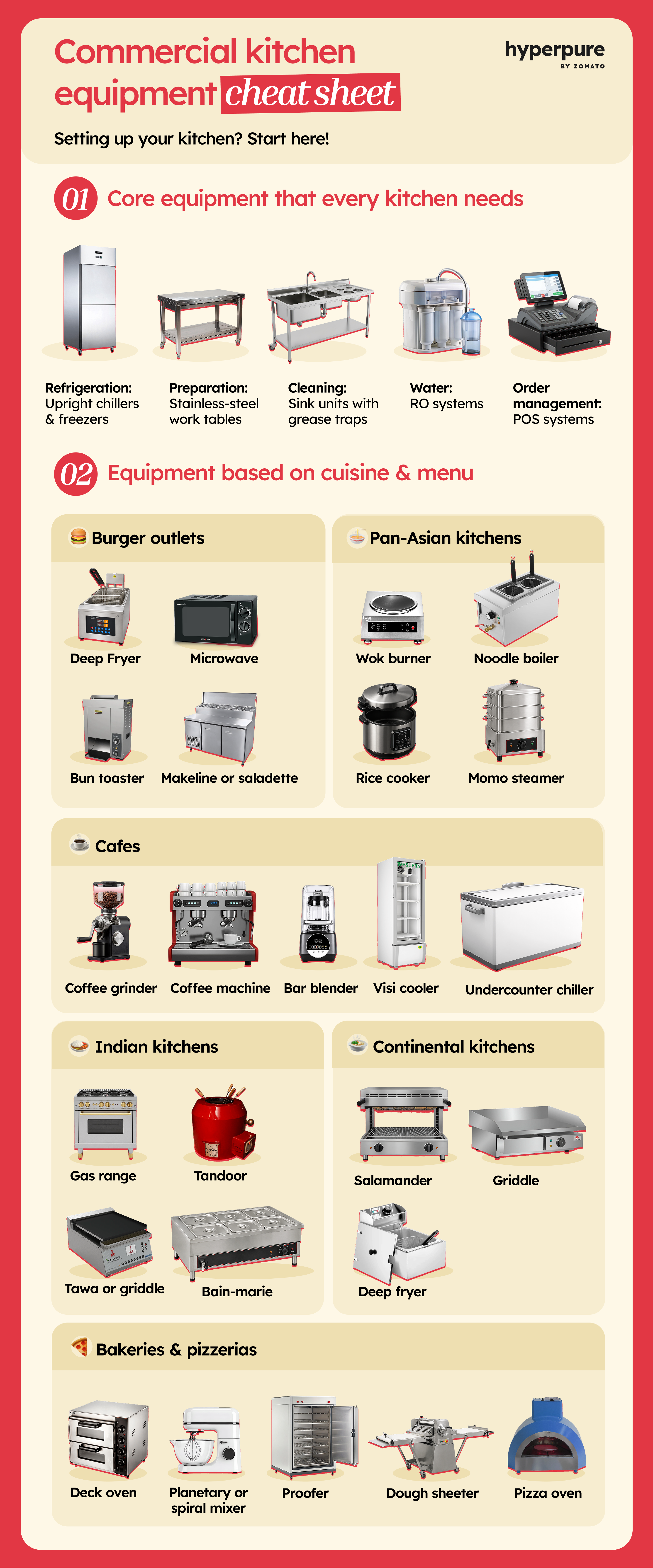
While certain equipment may vary depending on the cuisine and menu (which we will cover in Section 3), there is core equipment that all commercial kitchens need to plan for storage, preparation, cleaning, and daily operations:
- Upright chillers and freezers: Store raw ingredients and prepped batches safely at required temperatures.
- Undercounter chillers and freezers: Keep frequently used ingredients within reach right at workstations.
- Stainless-steel work tables: Provide durable, hygienic food-grade surfaces for preparation.
- Sink units with grease traps: Support cleaning and sanitisation while preventing grease from clogging drainage lines.
- RO systems: Provide clean, treated water for cooking and protect equipment from mineral scale buildup.
- POS systems: Help manage incoming tickets, kitchen communication, and billing smoothly.
Tip: Before deciding where equipment goes, map how ingredients move from storage to preparation, cooking, and service. For example, place your stainless-steel work tables and sink units right next to your upright chillers, well away from the POS system and pass. This ensures raw produce and prep work never cross paths with finished orders heading out to customers.
2. Choose refrigeration based on how you work
Commercial refrigeration comes in a range of capacities, and the right unit depends entirely on the job it has to do:
- Backbar cooler (133 to 314 litres): Fits under counters to store beverages, milk cartons, and bar garnishes.
- Visi cooler (292 to 466 litres): Features a glass door to display chilled drinks, pre-packed salads, and desserts in customer-facing areas.
- Two-door or four-door upright chiller or freezer (429 to 800 litres): The standard workhorse for back-of-house storage and bulk daily stock.
- Saladette or prep counter (240 to 392 litres): Combines top-well access with an undercounter cabinet, keeping toppings and sauces cool during assembly.
- Undercounter chiller or freezer (282 to 553 litres): Puts cold storage directly beneath active prep counters and cooking ranges.
Tip: Start with what you need to store, how often the door will be opened during a shift, and the operating temperature it requires. Overall litre capacity comes after that. For example, a busy station opened dozens of times an hour needs an undercounter chiller directly beneath it to recover cold air quickly, while bulk stock accessed only a few times a day is better kept in an upright chiller in the main storage area.
3. Match equipment to your cuisine and menu
Beyond the baseline essentials, your cuisine and menu dictate the equipment the rest of your kitchen needs. Here is what different formats require to run efficiently:
Burger outlets
- Key equipment: Deep fryer, flat or grooved griddle, makeline or saladette, upright chiller or freezer, bun toaster, and microwave.
- Tip: A makeline keeps frequently used ingredients within reach during assembly. Pair it with enough refrigeration and cooking capacity for peak hours. For example, keeping sliced cheese, sauces, and toppings in the chilled top pans of your makeline right beside your griddle allows a cook to plate and finish burgers in seconds without leaving the station.
Cafes
- Key equipment: Coffee machine, commercial coffee grinder, bar blender, visi cooler, and undercounter chiller or prep counter.
- Tip: Depending on your menu, plan space for a bakery display counter, an ice machine, or a sandwich griddle. For example, placing your bar blender, ice machine, and sandwich griddle right next to your coffee machine lets staff handle hot drinks and toasted snacks efficiently without stepping over each other during morning peak hours.
Bakeries and pizzerias
- Key equipment: Deck oven, planetary or spiral mixer, proofer, and dough sheeter. Pizzerias may also need a dedicated pizza oven and makeline.
- Tip: Look at your batch sizes and required output, then check how each machine fits into your preparation and baking process. For example, if your spiral mixer or planetary mixer prepares a 20 kg batch of dough, ensure your proofer and deck oven have the exact capacity to handle that full batch at once so dough does not sit out over-proofing on tables.
Indian kitchens
- Key equipment: Commercial gas range, tandoor, tawa or griddle, deep fryer, and bain-marie.
- Tip: Build around your core menu and service volume. A tandoori-focused kitchen has very different ventilation and space requirements from one focused on gravies and fried snacks. For example, a tandoori-focused menu needs your tandoor placed directly under the main extraction system to handle intense smoke, while a curry-led operation requires more burner space on the commercial gas range and a bain-marie to keep prepared gravies hot.
Chinese and Pan-Asian kitchens
- Key equipment: Double wok range, multi-tier momo or dimsum steamer, and more.
- Tip: If your menu features a large volume of noodle or rice dishes, or involves heavy daily vegetable preparation, look for equipment that speeds up those specific prep tasks. For example, utilising both wells on a double wok range allows one cook to flash-steam dim sums on the multi-tier momo steamer while simultaneously tossing noodles or rice on the woks during a rush.
Continental kitchens
- Key equipment: Combi oven, salamander, griddle, deep fryer, and more.
- Tip: Let your menu's cooking and finishing techniques guide what you buy. For example, use the combi oven for large-batch baking and roasting, then quickly crisp or melt cheese under the salamander or on the griddle right before serving.
4. Before you buy
Before finalising your equipment setup, run through these six essential checks before placing your orders:
- Menu and volume: What dishes will you serve, and how many orders do you expect during your busiest hours?
- Capacity and output: Can the equipment handle your peak service rush without causing delays?
- Space and workflow: Will the units fit comfortably while leaving clear aisle room for staff movement?
- Installation: Check electricity, gas lines, ventilation (extractor hood), and plumbing requirements before delivery.
- Total cost: Factor in delivery, installation, electricity or gas consumption, cleaning needs, and regular maintenance.
- After-sales service: Check warranty coverage, service availability and access to spare parts.
Tip: Start with the core equipment your primary menu depends on to open doors, then invest in specialised appliances as your business grows. For example, start your setup with essential items like an upright chiller, stainless-steel work table, and griddle or commercial gas range, then add extra pieces like a saladette or combi oven as order volume grows.
Build a kitchen that can grow with you
A good commercial kitchen fits your menu and your space, and it scales smoothly as customer demand grows. Taking the time to assess your layout, capacity, and operational workflow early saves you from expensive equipment replacements later on.
To make planning easier, we’ve also put together a commercial kitchen equipment cheat sheet to help you identify key equipment for different cuisines and what to consider before buying.
 Explore commercial kitchen equipment and supplies on Hyperpure, or write to us at hpkitchenware@zomato.com for help with your kitchen setup.