
How did modak look 900 years ago?
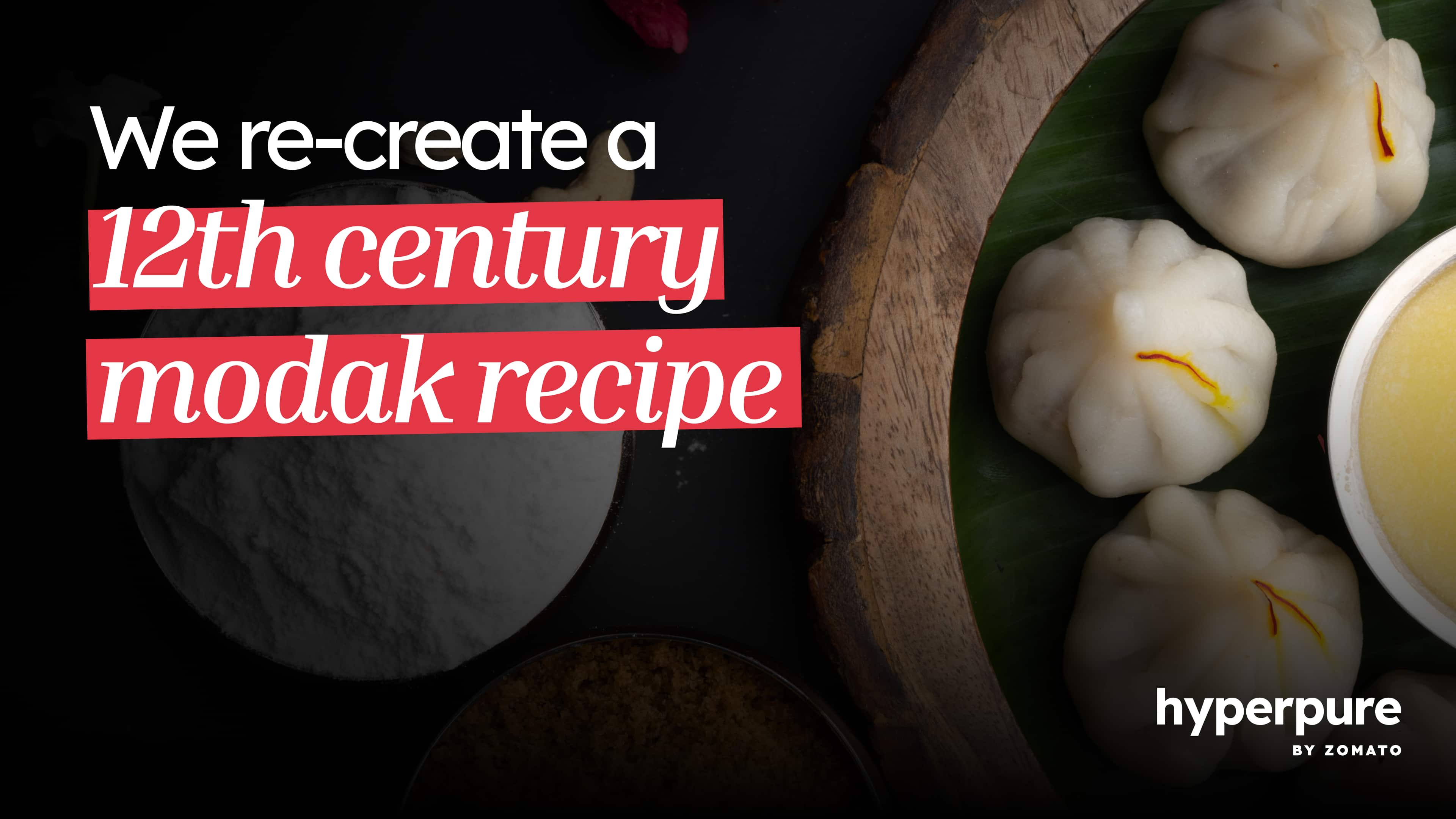
It's that time of year again. Sweet shops are filling up with modaks: the usual steamed ones, plus chocolate, pistachio, mango, dry-fruit, and increasingly elaborate versions from restaurants doing their own gourmet takes. Before thinking about where modak is headed, we wanted to know where it started.
A sweet with a long history
The word modaka shows up earlier than we expected. In Sanskrit, it comes from the root mod, meaning joy or delight, so modaka roughly translates to “that which brings joy.” The word appears in ancient Indian literature and Ayurvedic texts, and culinary historian Darra Goldstein dates the sweet to around 200 BCE. Sangam literature also describes vendors in ancient Madurai selling rice dumplings with sweet fillings.
We found one of the most interesting references in the Mānasollāsa, a 12th-century Sanskrit encyclopaedia from the court of King Someshvara III. Its pages cover everything from courtly life and music to food. Among its culinary descriptions is a preparation called Varsopalagolaka.
The name refers to a hailstone. It is described as a rice-flour sweet with a filling, flavoured with cardamom and camphor. It sounded remarkably close to the modak we know today.
But there was one important difference. Instead of the familiar pleated cone, imagine something small, round and smooth, closer to a hailstone. The possibility of recreating a sweet described nearly 900 years ago was too exciting for us to pass up.
So we tried to imagine it
The Mānasollāsa doesn't hand you a recipe with weights and cooking times, so we built our own version from the description.
Our 12th-century-inspired Modak
Makes 10–12
For the shell
- 100 g rice flour
- 120 ml hot water
- 1 tsp ghee
- A pinch of salt
For the filling
- 100 g grated coconut
- 75 g jaggery
- ½ tsp ground cardamom
- A tiny pinch of edible camphor, optional
Instructions
-
Cook the coconut and jaggery together until sticky. Stir in the cardamom and, if using, the camphor.
-
Mix the rice flour with hot water, ghee and salt into a soft dough. Divide it into small portions. Fill each with about 10–12 g of filling and seal.
-
Then do the part that feels wrong if you're used to making modak: don't pleat them. Roll each one smooth between your palms instead.
-
Steam for 8–10 minutes and serve warm with a little ghee.
The result looks nothing like a modern modak, which is really the point. It shows how much this sweet has changed over nine centuries.
We can't claim this is the exact sweet made in Someshvara III's kitchens. The coconut-jaggery filling is our own reconstruction. What the text actually gives us is the rice flour, the sweet filling, the aromatics, and the hailstone-like form.
What does this teach us about innovation?
Modak has never had one fixed form. A vendor in ancient Madurai, a cook in a 12th-century palace kitchen, and a sweet shop making chocolate modak this week are all doing something similar: taking a basic idea and making it their own. The shape shifts. The filling shifts. Even the name changes by region.
It also reminded us of something Matt Ridley, the British science writer and author of How Innovation Works: And Why It Flourishes in Freedom, writes about: innovation rarely happens as one dramatic invention. It tends to happen gradually, as people borrow, adapt and combine existing ideas.
Modak seems to have followed exactly that path. No one had to sit down and redesign it. One cook changed the filling. Another changed the shape. Someone else changed the technique. Over generations, those small experiments turned one version of the sweet into another.
The chocolate modak on shelves this year isn't an entirely new idea, per se. It's simply the latest version of a sweet we've been tinkering with for centuries.
And if you're running a sweet shop or dessert counter at a restaurant, we're here to help you keep experimenting. From the ingredients behind the classics to everything you need for your next festive creation, Hyperpure has you covered.