
How to source the right coffee for your restaurant or café
Coffee has become one of the fastest-growing revenue contributors in restaurants and cafés. Irrespective of the cuisine you serve, guests now expect you to offer at least a cappuccino or a latte on the menu.
If your coffee offering is well planned, from the beans and machine you choose to the consistency you maintain, customers are more likely to stay longer in your outlet. That longer dwell time is a strong signal of satisfaction and repeat potential, which over time supports healthier margins.
Yet many restaurants still choose their coffee based on what distributors or roasters are pushing to sell, rather than on a clear understanding of guest preferences, roast profiles, sourcing options, and on-ground operational realities.
This comprehensive guide provides restaurants and cafés with a detailed strategy for selecting the ideal coffee roast profile, beans, supplier, and equipment. It’ll help you provide the ideal coffee experience to your customers and maximise your coffee revenue.
1. Start with your Guest: What are they actually ordering?
Before choosing beans or machines, look closely at your customers:
- Hot vs cold coffee mix: In many metros, iced coffees now outsell hot coffees.
- Milk-heavy vs black coffee: Indian consumers overwhelmingly prefer milk-based drinks such as lattes, cappuccinos, iced coffees and frappés.
- Dwell time: Dwell time refers to how long customers spend at your restaurant. In long-dwell cafés and bakeries, customers sit for 45–90 minutes, work on laptops, or meet friends — these formats often benefit from more nuanced coffees. In QSRs, where guests leave quickly, speed and consistency matter more.
Understanding these patterns helps determine whether you need a balanced roast or something darker and fuller-bodied.
2. Roast profiles: Light vs medium vs dark
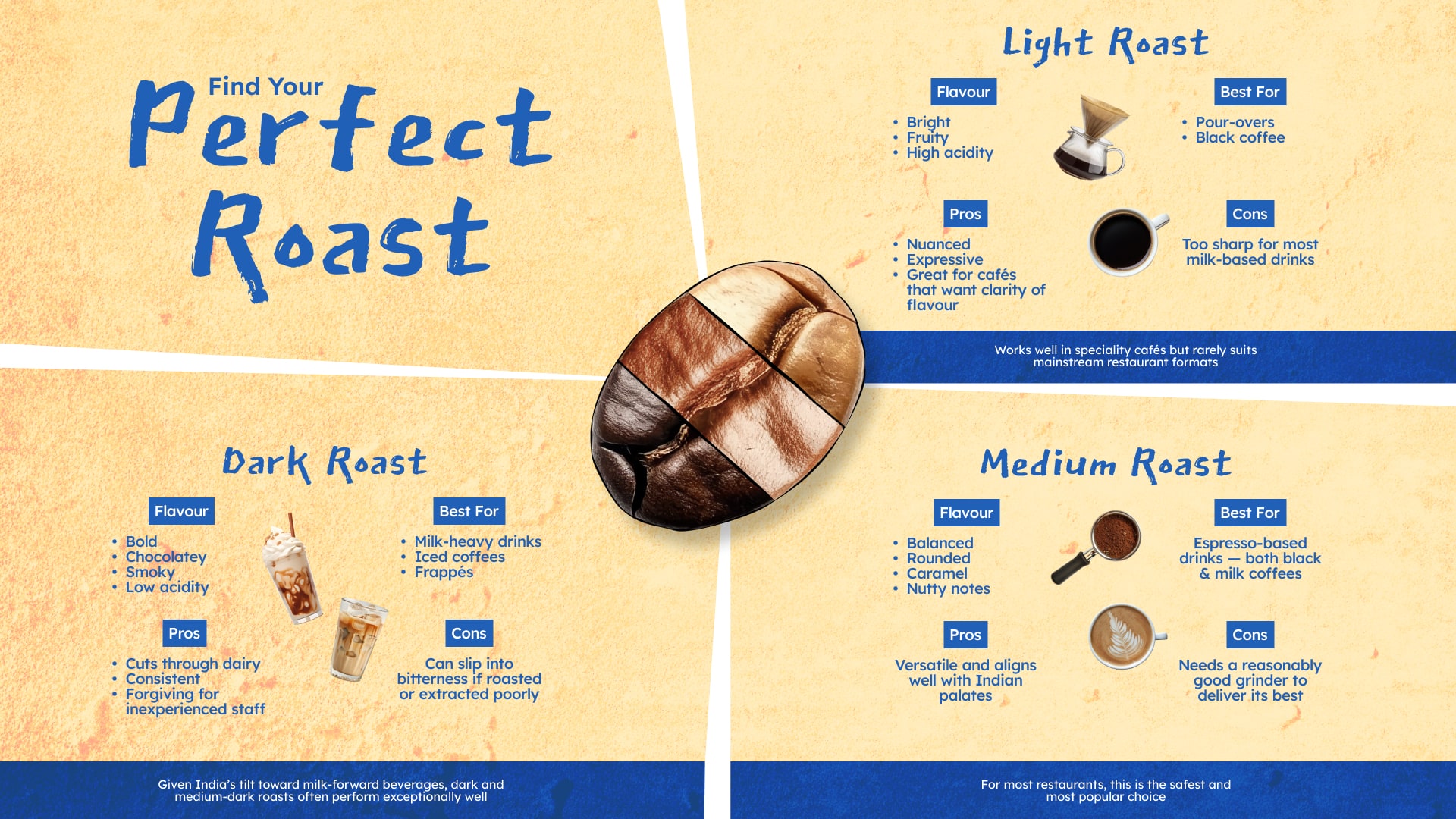
Light roast
- Flavour: Bright, fruity, acidic
- Best For: Pour-overs, black coffee
- Pros: Nuanced and expressive
- Cons: Too sharp for most milk-based drinks; unforgiving in high-volume settings
Medium roast
- Flavour: Balanced, rounded, caramel and nutty
- Best For: Espresso-based drinks
- Pros: Versatile, suits Indian tastes
- Cons: Needs a good grinder
Dark roast
- Flavour: Bold, chocolatey, smoky
- Best For: Milk-heavy and cold-coffee drinks
- Pros: Cuts through dairy, consistent
- Cons: Can taste bitter if overdone
3. Coffee beans: Arabica, robusta, and blends
100% arabica has historically been the preferred choice in specialty cafés and premium dining formats. Grown at higher altitudes and traded globally as the higher-grade coffee, it offers greater aromatic complexity and brighter acidity. This makes Arabica ideal for black coffee, pour-overs, and menus where guests are likely to appreciate nuanced flavours rather than milk-heavy preparations.
100% robusta, on the other hand, has long been favoured in traditional espresso cultures and high-volume foodservice. With nearly double the caffeine, a heavier body, and naturally thicker crema, Robusta performs better in milk-forward drinks like cappuccinos and lattes. Its lower cost and greater resilience in cultivation have also made it the backbone of consistent, scalable coffee programmes in restaurants and QSRs.
Arabica–robusta blends A balance of aroma, body, crema, and cost. In India, 70:30 or 80:20 blends work well for all-round menus.
4. Sourcing beans: Reliability, customisation, and long-term consistency
Once you’ve determined your roast and bean composition, the next step is choosing the right supplier.
Option 1: Traditional roasters
They offer:
- Fixed blends
- Standard roast levels
- Easy buying for small volumes
But limitations become clear as you scale:
- No customisation
- Batch variation
- Hard to maintain identical flavour across outlets
- Scaling becomes unpredictable
- Higher long-term costs
Option 2: Sourcing through Hyperpure
Restaurants and cafés looking for consistency, control, and scalability tend to prefer Hyperpure.
Hyperpure enables you to:
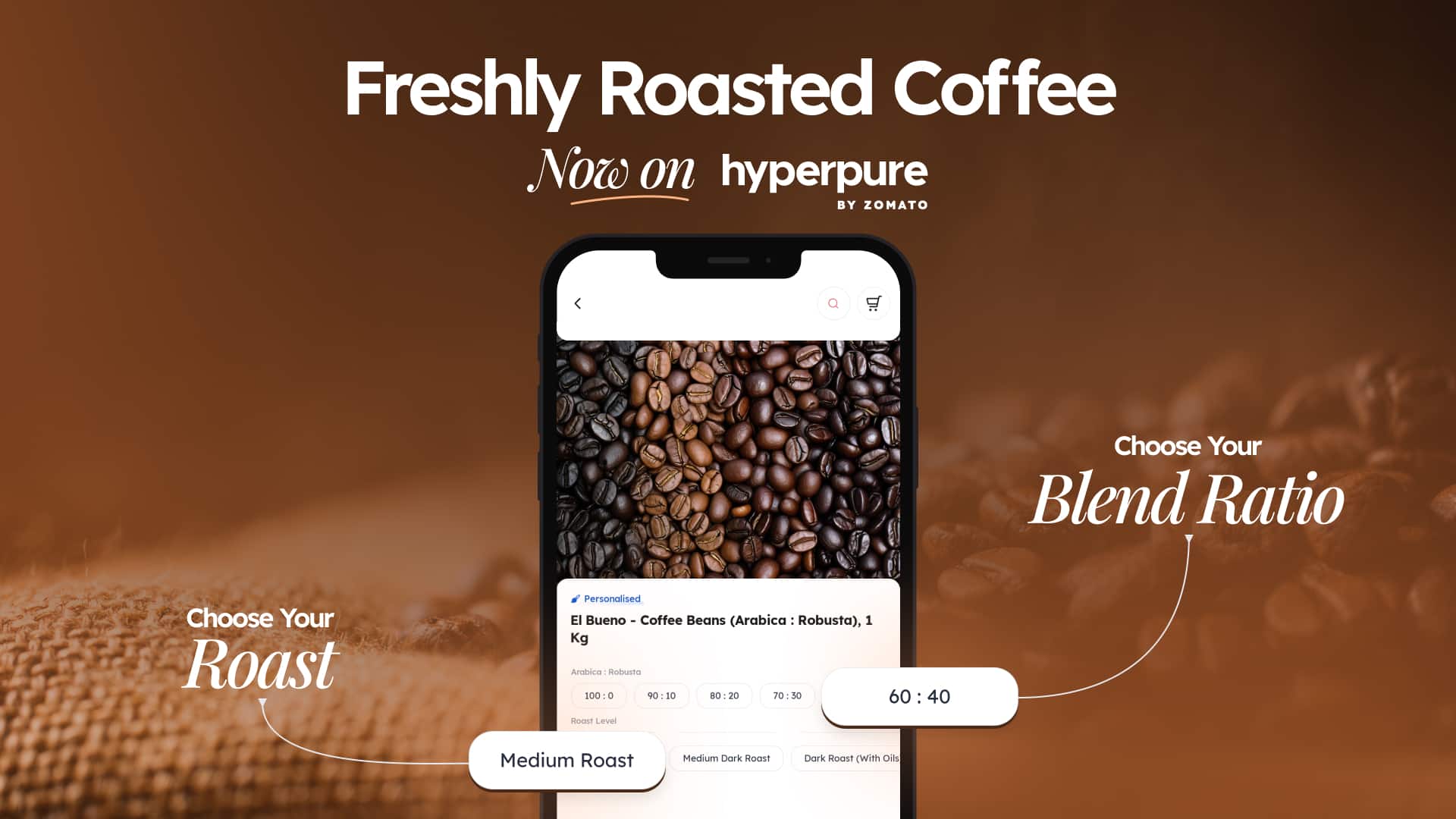
- Custom-design your roast (medium, medium-dark, or dark)
- Pick your Arabica–Robusta ratio based on flavour and margins
- Maintain identical taste across outlets and cities
- Adjust blends over time as customer preferences shift
With the Hyperpure app, you have the convenience of ordering your coffee along with all your other kitchen supplies, without juggling multiple vendors. Hyperpure delivers everything directly to your doorstep with predictable schedules and no minimum-order burden for most items.
Our coffee beans are sourced from respected estates in Karnataka, roasted fresh, and packed for consistent coffee experiences. You can order coffee beans at wholesale prices without large minimum-order quantity (MOQ) requirements. Check out our coffee roasting process here.
 For food businesses, this single-vendor convenience of getting ingredients, coffee, packaging, bread, and pantry items in one place reduces coordination time and keeps teams focused on operations, not procurement.
5. Machine choice: Match equipment to format
Fully automatic machines Best suited for QSRs and high-turnover teams. These machines prioritise speed, consistency, and ease of use, require minimal training, and reduce dependency on skilled staff, ideal when coffee is an add-on rather than the main draw.
Semi-automatic espresso machines Best for café-first or beverage-led menus. They offer greater control over flavour, but require trained baristas and tighter operating discipline to deliver consistent quality during peak hours.
Manual brew gear (pour-over, French press, etc.) Best for boutique or experience-driven concepts. While the upfront investment is lower, service is slower and staff training is critical, making this better suited to smaller volumes and customers who value craftsmanship.
Rule of thumb: If coffee contributes 10–20% or more of your revenue, invest in a semi-automatic machine. If coffee contributes under 5%, a fully automatic machine is usually the smarter, more efficient choice.
6. India-specific operational realities
Milk behaviour Indian milk typically has higher fat and lactose content, which changes how it steams, foams, and tastes in the cup. This can amplify sweetness but also makes overheating more likely, so always test your coffee with the exact milk brand you plan to use in service.
Heat and humidity High temperatures and humidity cause coffee beans to stale faster, dulling aroma and flavour. Buy smaller batches more frequently, avoid pre-ground coffee, and store beans in airtight, opaque containers away from heat.
Staff turnover With frequent staff changes, complex coffee setups often break down. Simple SOPs, forgiving roast profiles, and stable blends help maintain consistency even when experienced baristas are not always on shift.
7. Cold coffee dominance in India
Cold coffee now drives the highest volume in many urban markets.
This requires:
- Slightly darker roasts
- Lower acidity
- Higher body
The same beans can also be used to create high-margin, value-added drinks such as flavoured frappés, coffee-based cocktails, affogatos, and seasonal signature beverages—an easy way for restaurants to boost revenue and stand out on the menu. Light roasts do not hold up in these formats.
8. Pricing and menu engineering
Indian diners respond particularly well to formats that balance familiarity, value, and indulgence:
- Accessible Americanos: Lower milk usage keeps costs down, while the familiar profile works well for office-goers and repeat weekday consumption.
- Premium cold brews: Cold brews command higher price points, especially when flavoured or positioned as seasonal or limited-time offerings, making them one of the highest-margin coffee items on the menu.
- Smaller cup sizes: Smaller serves keep the coffee hot and flavour-forward throughout the drink, improve perceived quality, and reduce ingredient waste without customers feeling short-changed.
- Coffee + dessert pairings: Simple bundles with brownies, cookies, or slices increase average order value with minimal additional kitchen effort or operational complexity.
- Limited signature beverages: Two or three house specials, iced, spiced, or dessert-style, create menu differentiation without bloating inventory.
Your roast and machine choices must allow healthy margins.
Conclusion: Build a coffee offering, Not Just a product
A strong coffee offering in India is built on a few fundamentals:
- The right roast profile
- A thoughtful Arabica–Robusta balance
- A sourcing partner that enables customisation and consistency
- Equipment matched to your service volume
- Simple, India-aware SOPs that work on the ground
For most cafés and restaurants, especially those serving milk-heavy or cold-coffee menus, a medium or medium-dark customised blend offers the best balance of flavour, cost control, and scalability when sourced through a reliable partner like Hyperpure.
If you’re looking to build a consistent, scalable, and customised coffee offering for your restaurant or café, you can explore Hyperpure’s custom-roasted coffee here.